Thursday, June 25, 2009

San Francisco Signs Mandatory Recycling & Composting Laws

Just yesterday On June 23rd, the City of San Francisco signed into effect the nation’s first law mandating that all residents and businesses separate their recycling and compost material from normal trash. While many other cities in the US require recycling, no other city requires separation of food scraps and foot material to be composted. The measure, which will take effect this fall, is intended to help increase landfill diversion rates to 75% by 2010 as well as reduce greenhouse gas emissions.

San Francisco is already well known for it’s impressive recycling and participation rates. The city diverts 72% of it’s trash from the landfill, and if everyone in the city participated in the new mandate, the Department of the Environment expects they could reach a 90% diversion rate. Ultimately though, the city has a goal of zero waste by 2020. The Department of the Environment conducted a study and determined that 36% of what is sent to the landfill is compostable and 31% is recyclable, most of which is paper.

Every residence and business in the city will be expected to have 3 different color-coded bins to separate their trash: blue for recyclables, green for compostables, and black for the remaining trash. Residences and businesses that cannot comply with the mandate can write the city a note explaining why it is unfeasible.

The purpose behind the mandate was to encourage businesses and residents who currently don’t recycle to start participating. San Francisco Mayor Gavin Newsom wants to “get recycling and composting happening in buildings where it is not currently provided.” And while there are fines associated with noncompliance of the recycling and composting ordinance, fines are not expected to be handed out except in extreme cases. The potential for fines is meant to increase awareness and add a sense of urgency to the matter, but they will only be implemented after repeated notices and phone calls. Additionally, a moratorium on fines is in effect until 2011.

The Board of Supervisors passed the measure, which is the first of it’s kind in the US, 9-2 on the first read through. “San Francisco has the best recycling and composting programs in the nation,” Newsom said, praising the board’s vote on a plan that some residents had decried as heavy-handed and impractical. “We can build on our success.”

Tuesday, June 9, 2009

Wyoming University Students Study Grow Biointensive in Kenya


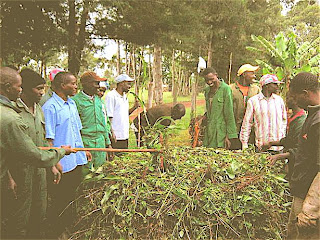
We just received these pictures from Philip Munyasia, a GROW BIOINTENSIVE instructor in Kenya. The pictures from top: the bountiful harvests possible using this method of agriculture, Philip with Professor Rick Smith from University of Wyoming USA, Kenyan students demonstrating the making of compost the Grow Biointensive way (using plant material and soil only), and Kenyans demonstrating biointensive planting to University of Wyoming students using close spacing in double dug beds. Click on pictures to enlarge. More pictures at Philip's blog site:
http://organicfarminghealingtherift.blogspot.com/

An inspiring vision of possibilities for Ezemvelo!

Saturday, June 6, 2009

Tuesday, May 26, 2009

Why Rural Empowerment is Important

Azharuddin Mohammed Ismail, the ten-year-old star of Slumdog Millionaire, lost his home ten days ago. It was torn down by authorities in Mumbai. The Guardian reports that city authorities said the land was needed for a garden.

So writes Robert Neuwith on his blog SquatterCity. "These neighborhoods--which dominate most of the cities of the developing world--are vibrant and energetic, but horribly misunderstood. My book, Shadow Cities, is an attempt to humanize these maligned settlements."

Having spent two years living in squatter communities across four continents, Neuwirth finds people living lives of complexity, challenge, and surprising resiliency.

To understand more about this pressing problem of migration of the rural poor to the cities please see this video here.

Also see our earlier post on a thriving organic farm that has arisen in the midst of Kenya's largest squatter city.

Monday, May 25, 2009

Biointensive Garden Progress-2

We've double dug 22 raised beds in 4 weeks. Each bed is 100 square feet or 9.2 square meters. First we thoroughly soak the soil for at least 24 hours. Then remove all grass and weeds for composting. Then double dig the soil to 2 foot depth (6oomm) below the surface. When the soil is returned it is higher due to air added to the soil, so overall the cultivated depth is 600-850mm. This is much deeper than most systems of farming and allows for a closer spacing of plants.

Research at Ecology Action has shown that 40 such beds will adequately supply all the nutrition needs for one year for one person as well as carbon crops to compost for the soil and sufficient income for one person. In South Africa, organic produce sells for approximately double the rate of non-organic produce. So 40 beds should enable a good income as well as healthy food for the family.

We’ve made both the curved top beds used in biointensive gardens (bottom picture, click to enlarge) and the “flat top” often favoured in Africa for raised beds (top picture). We found that the planted area is up to 25% more for the curved top so this is our preferred design. It does require more care with watering until the plants are well established to prevent soil erosion.

Most of the crops we’ve planted initially are soil building cover crops including clover, Luzerne alfalfa grass, fodder radish and fodder rape. The GROW BIOINTENSIVE method encourages planting by the moon, which we have done. Additionally we are doing some planting using a Biodynamic calendar based on the teachings of Rudolph Steiner. The Biodynamic Calendar considers the moon and also the planets for choosing the best planting times. Ezemvelo means "return to nature" and so we teach methods which have been verified by science to be in harmony with and be supported by nature.

The top picture shows biointensive agriculture instructor Simphiwe Tinini demonstrating the biointensive method for spacing plants in a hexagonal pattern which maximizes foliage cover of the soil to reduce soil erosion and inhibits weed growth by shutting out the light.

Thursday, May 21, 2009

Grow Bio-Intensive – a Brief Description


Onions, avg yield 380lbs/100 sq ft

From: http://harmony-essentials.com/biointensive.html

Bio-Intensive agriculture is a millennial old production technique that uses low tech methods for food production.

Over the last 35 years John Jeavons has developed these timeless techniques into a system that can be used to attain sustainable food production. He has developed a matrix of these dimensions: calories for people and carbon for the soil in the smallest area possible using the least amount of resources. These developments are being called Grow Bio-Intensive to differentiate them from the older potentially unsustainable methods.

Grow Bio-Intensive is based on a balance of eight important elements:
* Deep soil preparation, with Raised Beds
* Composting
* Intensive Planting
* Companion Planting
* Carbon Farming
* Calorie Farming
* Open Pollinated Seeds
* Holistic Farming Method

GROW BIO-INTENSIVE mini-farming techniques make it possible to grow food using:
* 67% to 88% less water
* 50% to 100% less organic fertilizer
* 99% less energy than commercial agriculture

These techniques can also:
* Produce 2 to 6 times more food
* Build the soil up to 60 times faster than in nature, if properly used
* Reduce by half or more the amount of land needed.

More information on Grow Bio-Intensive can be found here and at our upcoming 5 day workshop at Ezemvelo, September 16-21.

Impala

This impala has been coming into the campground every night for the last several weeks, along with a herd of about 15 smaller impala. This photo was taken last night at sunset, his usual time for arriving at the camp. They come for the proximity to humans at night as the leopards hunt at night and thankfully keep their distance from humans. At the last count in 2006 14 leopards were counted at Ezemvelo and Telperion Reserves.

Tuesday, May 19, 2009

Interns Get a Lesson on Thatching


One of the interns today gave us a demonstration on thatching by reroofing our small kitchen at Eland Lapa. Pictured is Director from Hazyview in Mpumalanga.

Sunday, May 17, 2009

Cob Homes in Cullinan


I visited two delightful homes today in Cullinan, just a short drive west of Ezemvelo. I helped with construction of a home made of cob in Iowa, USA, last year. Cob refers to the clay-sand-straw mix used to make the walls. It comes from Europe where there are homes that have survived for 100's of years made of cob. It's very suitable for South Africa as it is very inexpensive, and the homes are cool in summer and warm in winter. And unlike in USA, cob homes can only get building permits in South Africa if the walls are not structural. This turns out to be an advantage in that the roof must go up first, supported by round wood poles. So the slow process of making the walls can proceed in all weather conditions under the roof.

The creativity that this method allows is seemingly endless. The homes I saw had very beautiful recycled glass windows of all shapes and sizes, shelves, bathtubs, sinks, counters, nooks and bench seats all made of cob. I was truly impressed and present some pictures here for something to consider for exhibiting different sustainable building technologies at our planned eco-campus at Ezemvelo.

See our earlier post on Building with Earth.

Saturday, May 9, 2009

Greenhouse Expert coming to South Africa

Steve Moore was affectionately termed the "Gandhi of Greenhouses" by his students for his low tech innovations to keep his plants warm in winter without using fossil fuels.

He is coming to Ezemvelo in September to assist John Jeavons in the Food and Our Future 5 day workshop we're presenting here. In the relatively mild winters of South Africa it is possible to grow year round with only modest protection from the cold winter nights.

Some of his low-cost greenhouse innovations are described here:
http://newfarm.rodaleinstitute.org/features/0404/moore/greenhouse.shtml

Pictured above is Steve and his wife Carol on the cover of Home Power magazine in 2004.

Friday, May 8, 2009

Food and Our Future: Hope and Solutions through Biointensive Farming.

John Jeavons and Steve Moore present the GROW BIOINTENSIVE™ farming method in a 5-Day Workshop, Wednesday to Sunday, September 16-20 at Ezemvelo.

(click here to download the Ezemvelo April Newsletter)

The GROW BIOINTENSIVE method gives farmers and
gardeners of all skill levels the potential to use up to
67-88% less water, and 94-99% less energy per unit of
production compared with conventional farming and
gardening methods. At the same time the method creates
a substantial increase in soil fertility and yields.

The workshop will cover eight essential aspects of the
GROW BIOINTENSIVE method including: Deep Soil
Preparation, Raised Beds, Composting, Intensive Planting,
Companion Planting, Carbon Farming, Calorie Farming,
Use of Open-Pollinated Seeds, and A Whole-System
Farming Method. John will also provide time for questions
and answers concerning small-scale farming, long-term sustainable soil fertility, climate and market challenges.

John Jeavons has been the director of Ecology Action’s Mini-Farming programme since 1972, is the author of How to Grow More Vegetables...” (the textbook of the GROW BIOINTENSIVE Sustainable Mini-Farming system), and has authored, co-authored and/or edited over 30 other Ecology Action publications. He directs research and education in GROW BIOINTENSIVE food raising methods, advises biologically-intensive projects in 141 countries around the world, and holds a B.A. in Political Science from Yale University. He has received the Boise Peace Quilt, Santa Fe Living Treasure, Giraffe, and Steward of Sustainable Agriculture awards for public service.

Ezemvelo is offering special 5 day accommodation packages including all meals and course tuition as follows (R/person):

Rhino House (2 persons/ room) R3250
Legae-Chalets (3 persons / chalet) R3175
Family Huts (3 persons/room) R3025

Group rates:
Hikers Huts (16 per dorm room) R2850
Impala Lapa (8 per dorm room) R2850
Caravan & Camping (max 6 per stand) R2700

Workshop and meals only R2300

Accommodation is limited and will be allocated on a first come
first served basis with full payment.

For bookings and further information:
E-mail: horsfield@lisco.com or ezemvelo@telkomsa.net
Tel: 013 680 1399 / 083 440 5886 /083 655 3638/ 083 287 6832

Thursday, May 7, 2009

Economies of Small Scale in Agriculture: A lesson for Congo

I post this recent story as case study for sustainable development pertaining to South Africa. The Government of the Democratic Republic of Congo has decided to deal with food shortages and poverty by giving free 99 year leases on 10 million hectares of land to South African farmers to produce maize, soybeans, poultry and dairy farms. It raises serious questions such as:

• How many local people will be displaced in this process of giving land away to foreigners?

• What will be the environmental cost of destroying rain forest up to twice the size of Switzerland to make way for genetically modified maize, soybeans and poultry and cattle farms?

Here at Ezemvelo, natural wildlife habitats have been restored by removing cattle farms, and poultry and pig raising buildings in order to create a nature reserve over 10,000 hectares (Ezemvelo adjoins the private Telperion Nature Reserve).

Research at Ecology Action in the USA has shown that with GROW BIOINTENSIVE agriculture farmers can approximately double the output per unit area of land of conventional agriculture, and sometimes up to four times the yield. These biointensive food raising principles are based on a foundation of traditional forms of agriculture that are thousands of years old. Moreover, unlike with modern conventional agriculture, soil is not diminished in the process but is increased. The conclusions are clear: there are significant “economies of small scale” in food production.

The Government of Congo could serve it’s people far better by improving food production on currently farmed land with biointensive farming methods. These methods, combined with a better understanding of crop calorie efficiency of predominantly vegetarian diet versus a meat-based diet could enable up to half of the world’s present farmland to be returned to wild areas to preserve the plant and and animal biodiversity that is essential to promote balance in the global ecosystem.

There is no need to destroy more rain forest to feed the world.

Congo Republic Offers Huge Land Area to South African Farmers

SustainableBusiness.com News 04/16/2009

The Republic of Congo has offered South African farmers 10 million hectares of farm land in an effort to increase the country's food security.

The area of land is twice the size of Switzerland and is to be used for growing maize and soy beans as well as poultry and dairy farming.

South Africa has one of the most developed agriculture sectors on the continent, and is Africa's top maize producer and No.3 wheat grower.

"They've given us 10 million hectares, and that's quite big when you consider that in South Africa we have about 6 million hectares of land that is arable," said Theo de Jager, deputy president of the farmers union Agriculture South Africa.

The deal, which is to be finalized next month, will be a 99-year, no cost lease.

Source: Reuters

Monday, May 4, 2009

Scholarships for September Grow Biointensive Five-Day Workshop


We have some scholarships available for the 5 Day Grow Biointensive Workshop we're having at Ezemvelo taught by John Jeavons. For more information about the course go to the post Food and our Future.

One student in the US is raising funds for a teenage woman to attend the workshop. Sarah Moore was assigned a High School Freshman Project. As she thought of what she might do, her thoughts focused on hunger throughout the world. A preliminary investigation revealed that children and women suffered the most. Sarah had a basic understanding of GROW BIOINTENSIVE (GBI) principles and felt that supporting a GBI project she could make a difference. She studied hunger and the geographic distribution throughout the world. She thought initially about raising money for seeds, but an e-mail to Brian Horsfeld in South Africa revealed a financial need to sponsor someone to the fall 2009 John Jeavons South Africa Workshop. Sarah raised over $200 to sponsor a teenage woman to the workshop. If others are interested in sponsoring or would like to refer a young women to be sponsored please contact Sarah at goldtkdgirl@gmail.com

Hey! My name is Sarah Moore and I’m a freshman at the Wayne School of Engineering in North Carolina. As part of a humongous project for my school, I had to research a subject and present it to a panel of judges. I chose to do mine on world hunger, and specifically, on solving world hunger through GROW BIOINTENSIVE principles. I studied hunger and these principles, and realized that women and children suffer the most from this world problem. So, as part of my project I raised over $200 at school and in my community to sponsor a young women to go to the September 2009 John Jeavons South Africa Workshop at Ezemvelo Nature Reserve. If you want to contact me or help me send a young woman to this workshop, e-mail me at goldtkdgirl@gmail.com. Can’t wait to hear from you!!

Saturday, May 2, 2009

Biointensive Garden Progress


Biointensive gardening is progressing well. We created an inexpensive storage tank for our free gravity fed spring water system. The tank is made of one piece of poly sheeting 7 x 6 meters supported by poplar posts and some old fencing (top picture). It stores 2000 liters of water for a total cost of R118. Filling buckets and watering cans is much quicker from this tank than from a hose.

We also started biointensive beds 9 and 10. Each bed is 100 square feet or 9.3 square meters. In order to double dig to 2 foot (600mm) depth it is much easier if the ground is moist. Since we have a free supply of water 24 hours a day we made a trench to irrigate the 2 beds for 24 hours. It's amazing how easily a spade will slide into properly moistened soil. Our motto is "if it is hard work, STOP before you break something, you're doing it the wrong way." Done properly double digging should be easy and fun.

The third picture shows our temporary nursery area with 22 seed flats planted so far. The seed flat trays are 3 inches (75 mm) deep and made from old apple boxes lined with plastic, with drain holes in the bottom. We will move the nursery into one corner of the main garden soon.

The last picture shows our system for making seed flat soil. We don't yet have compost made so we are improvising by collecting leaf mold (the top 5 mm of soil raked up under leafy trees). A quick way to sift this is to use a 15 mm mesh screen tilted at a high angle (in this case supported by an old bed frame). Though the mesh size is larger than ideal, when tipped at a high angle the coarse particles roll down easily off the screen and the sifted material is about 6mm or less. It's much faster and much easier than the traditional horizontal 1/4" (6mm) screen often placed over a wheelbarrow.

Sunday, April 26, 2009

Could Food Shortages Bring Down Civilization?

A new article by Lester Brown of the World Watch Institute in the latest issue of Scientific American Magazine examines this question. This is a highly important issue, and the GROW BIOINTENSIVE approach we are teaching here at Ezemvelo produces food with a fraction of the energy, water and soil amendments of conventional approaches. 34 students on a the Leadership Course here this week, spent this morning learning how to make new soil from plant based compost and how to conserve water and promote healthier plants with higher yields by double digging a new vegetable bed for our new GROW BIOINTENSIVE demonstration garden.

The following two posts are alarming, and one needs to remember that the root of the word "crisis" has the same origin as "circle", ie that a crisis represents lack of balance, and the beginning of a return to balance again. It seems we humans need to be pushed to the brink of catastrophe before we will change our ways! Also the word for "crisis" in Chinese is associated with the word "opportunity".

From the May 2009 Scientific American Magazine

Could Food Shortages Bring Down Civilization?

The biggest threat to global stability is the potential for food crises in poor countries to cause government collapse

By Lester R. Brown

  • Food scarcity and the resulting higher food prices are pushing poor countries into chaos.
  • Such “failed states” can export disease, terrorism, illicit drugs, weapons and refugees.
  • Water shortages, soil losses and rising temperatures from global warming are placing severe limits on food production.
  • Without massive and rapid intervention to address these three environmental factors, the author argues, a series of government collapses could threaten the world order.
One of the toughest things for people to do is to anticipate sudden change. Typically we project the future by extrapolating from trends in the past. Much of the time this approach works well. But sometimes it fails spectacularly, and people are simply blindsided by events such as today’s economic crisis.

For most of us, the idea that civilization itself could disintegrate probably seems preposterous. Who would not find it hard to think seriously about such a complete departure from what we expect of ordinary life? What evidence could make us heed a warning so dire—and how would we go about responding to it? We are so inured to a long list of highly unlikely catastrophes that we are virtually programmed to dismiss them all with a wave of the hand: Sure, our civilization might devolve into chaos—and Earth might collide with an asteroid, too!

For many years I have studied global agricultural, population, environmental and economic trends and their interactions. The combined effects of those trends and the political tensions they generate point to the breakdown of governments and societies. Yet I, too, have resisted the idea that food shortages could bring down not only individual governments but also our global civilization.

I can no longer ignore that risk. Our continuing failure to deal with the environmental declines that are undermining the world food economy—most important, falling water tables, eroding soils and rising temperatures—forces me to conclude that such a collapse is possible.

Full article here...

A Water Warning

Peter Brabeck-Letmathe, chairman of Nestlé, argues that water shortage is an even more urgent problem than climate change
Reuters
Reuters

The rise in the price of basic food has had devastating effects on the most vulnerable—the poor who spend up to two-thirds of their income on food. Some of the measures taken in response, such as export restrictions, have been highly counter-productive. In 2009 the world needs to reflect on the underlying causes of the food crisis and start addressing structural factors, in particular the link to biofuels and water.

Frank Rijsberman, from the Sri Lanka-based International Water Management Institute, gave warning in 2003 that if current trends continued, the livelihoods of one-third of the world’s population could be affected by water scarcity by 2025: “We could be facing annual losses equivalent to the entire grain crops of India and the United States combined.” Normally, when people hear about water scarcity they think of tap water; he talked about crops. And the dimension of the problem ahead is vast: America and India combined produce about 30% of globally consumed cereals.

Continued here...

Saturday, April 25, 2009

Student Hike


Students from the Maharishi Institute in Johannesburg begin their one week course on Leadership with a 3 hour hike. We walked from Reception past remains of a kraal and rondaval hut east of the main dam. From there we followed animal tracks to the old farmhouse (middle picture), and up by single file on a well-used animal track to the spring (at lower left in bottom picture) near block 14. Just close to this spring is another old kraal where the students rested (top picture). This path marks the main route between the spring and the Wilge River and is likely thousands of years old. There is evidence of human habitation in this area dating back to the Middle Stone Age (about 250,000 to 25,000 years ago).

Understanding the environment of our ancestors here provides an opportunity to understand how people have learned to live in harmony with nature over the ages.

Thursday, April 23, 2009

Enlightened Leadership


Today a group of 40 students arrive at Ezemvelo from the Maharishi Institute in Johannesburg for a weeks course on Leadership. So it's very fitting that this week in a newspaper report from London the former President of Mozambique, while receiving a $5 million award for Achievement in African Leadership, is quoted as crediting group practise of Transcendental Meditation for bringing "political peace and balance in nature in my country."

An excerpt from London's Independent:

Joaquim Chissano: Democrat among the despots

Sunday, 19 April 2009
By Claire Soares

Yesterday, however, at City Hall in London, the focus was on Africa's good things. Well one good thing to be precise – Africa's equivalent of the Nobel Prize, whose very first winner is Joaquim Chissano, the former President of Mozambique.

It was without doubt the most lavish of all the presents Mr Chissano received as he celebrated his 68th birthday yesterday. The Achievement in African Leadership, to give it its proper name, comes with $5m in prize money, making it the world's largest individual award.

While the financial gains leave the real Nobel (with its comparatively paltry $1.5m pot) for dust, the African version lags behind the Oslo original in one respect. It is not quite so slick at getting hold of the winner. "It has been difficult to reach the former president," Mr Annan, the former UN Secretary-General who led the panel of six judges, said with a sheepish grin.

Yet there was no need for embarrassment. The absence of Mr Chissano from the ceremony was, in fact, entirely in keeping with the Mozambique leader, who is the antithesis of the stereotypical African Big Man. While egomaniacs would be fidgeting by the phone, waiting for that all-important call, Mr Chissano was busy in southern Sudan on a United Nations mission to broker peace between the Uganda government and the rebel Lord's Resistance Army. "It shows the dynamism of the ex-president that he is still travelling and doing his good work. But we will find him," Mr Annan promised.

Mr Chissano is living proof that power doesn't have to go to the head. Perhaps his zen comes from the Transcendental Meditation he is said to practise. Indeed, in literature published by devotees of Maharishi Mahesh Yogi, Mr Chissano is quoted as saying: "First, I started the practice of Transcendental Meditation myself, then introduced the practice to my close family, my cabinet of ministers, my government officers and my military. The result has been political peace and balance in nature in my country."

Full story here...

Today also is the day after South Africa's General Election. It seems fitting then that the new government should take heed from this giant among African Leaders, and that political peace and balance in nature is available now following the experience learned in Mozambique.

Related links:

Recent editorial in USA Today by Dr John Hagelin and Maj. Gen. Singh describes how Invincible Defence Technology can help any nation

Major Werner Klokow in the South African army suggests the South African military should follow the example of Mozambique and have the soldiers practice Transcendental Meditation in a group to promote peace in the country.

See articles Major Klokow has posted here:
http://rsasoldier.blogspot.com/2009/02/meditation-is-path-to-peace-mozambique.html
http://rsasoldier.blogspot.com/2009/02/invincible-south-africa.html
http://rsasoldier.blogspot.com/2009/01/invincible-defence-technology.html

Monday, April 20, 2009

Monsanto GM-corn harvest fails massively in South Africa

By Adriana Stuijt.
Published Mar 29, 2009

South African farmers suffered millions of dollars in lost income when 82,000 hectares of genetically-manipulated corn (maize) failed to produce hardly any seeds.The plants look lush and healthy from the outside. Monsanto has offered compensation.

Monsanto blames the failure of the three varieties of corn planted on these farms, in three South African provinces,on alleged 'underfertilisation processes in the laboratory". Some 280 of the 1,000 farmers who planted the three varieties of Monsanto corn this year, have reported extensive seedless corn problems.

Urgent investigation demanded

However environmental activitist Marian Mayet, director of the Africa-centre for biosecurity in Johannesburg, demands an urgent government investigation and an immediate ban on all GM-foods, blaming the crop failure on Monsanto's genetically-manipulated technology.

Willem Pelser, journalist of the Afrikaans Sunday paper Rapport, writes from Nelspruit that Monsanto has immediately offered the farmers compensation in three provinces - North West, Free State and Mpumalanga. The damage-estimates are being undertaken right now by the local farmers' cooperative, Grain-SA. Monsanto claims that 'less than 25%' of three different corn varieties were 'insufficiently fertilised in the laboratory'.

80% crop failure

However Mayet says Monsanto was grossly understating the problem.According to her own information, some farms have suffered up to 80% crop failures. The centre is strongly opposed to GM-food and biologically-manipulated technology in general.

"Monsanto says they just made a mistake in the laboratory, however we say that biotechnology is a failure.You cannot make a 'mistake' with three different varieties of corn.'

Demands urgent government investigation:

"We have been warning against GM-technology for years, we have been warning Monsanto that there will be problems,' said Mayet. She calls for an urgent government investigation and an immediate ban on all GM-foods in South Africa.

Of the 1,000 South African farmers who planted Monsanto's GM-maize this year, 280 suffered extensive crop failure, writes Rapport.

Monsanto's local spokeswoman Magda du Toit said the 'company is engaged in establishing the exact extent of the damage on the farms'. She did not want to speculate on the extent of the financial losses suffered right now.

Managing director of Monsanto in Africa, Kobus Lindeque, said however that 'less than 25% of the Monsanto-seeded farms are involved in the loss'. He says there will be 'a review of the seed-production methods of the three varieties involved in the failure, and we will made the necessary adjustments.'

He denied that the problem was caused in any way by 'bio-technology'. Instead, there had been 'insufficient fertilisation during the seed-production process'.

And Grain-SA's Nico Hawkins says they 'are still support GM-technology; 'We will support any technology which will improve production.' see

He also they were 'satisfied with Monsanto's handling of the case,' and said Grain-SA was 'closely involved in the claims-adjustment methodology' between the farmers and Monsanto.

Farmers told Rapport that Monsanto was 'bending over backwards to try and accommodate them in solving the problem.

"It's a very good gesture to immediately offer to compensate the farmers for losses they suffered,' said Kobus van Coller, one of the Free State farmers who discovered that his maize cobs were practically seedless this week.

"One can't see from the outside whether a plant is unseeded. One must open up the cob leaves to establish the problem,' he said. The seedless cobs show no sign of disease or any kind of fungus. They just have very few seeds, often none at all.

The South African supermarket-chain Woolworths already banned GM-foods from its shelves in 2000. However South African farmers have been producing GM-corn for years: they were among the first countries other than the United States to start using the Monsanto products.

The South African government does not require any labelling of GM-foods. Corn is the main staple food for South Africa's 48-million people.

The three maize varieties which failed to produce seeds were designed with a built-in resistance to weed-killers, and manipulated to increase yields per hectare, Rapport writes.

Read the source and comments here...

Sunday, April 19, 2009

A new map of Ezemvelo


We've completed a new map of Ezemvelo. Click on image to enlarge. This is being distributed at Reception. On the back is the map of the very popular Penduka Trail.

A simple water system

We finished the fence enough to begin the gardens last week. Still have to add electric fencing on the top for the baboons and monkeys. To source water, we made a simple dam from a small trickle of water higher up the hill. This drains a large marshy area and flows most of the year. 70 meters of pipe was all that was needed to give us a very adequate supply of water. The outflow is seen at top soaking the ground in preparation for double digging to 2 foot depth. The interns each have their own GROW BIOINTENSIVE 10 square meter bed so they can learn all stages of biointensive food raising.

Friday, April 17, 2009

Interns start work on Biointensive Gardens


We're putting in a gravity fed water system for the garden so we won't have to pay electric bills to pump from the main borehole. Walking up to a marshy area to locate a site for a dam I found the remains of an ancient dam. A few large stones in a straight line deep into the grass. So it seems a validation of our choice of location - people have found this area many years before us and captured the very same water we'll be using in the garden.

We have not yet made wooden seed flats to start seedlings so local intern Thabo is pictured improvising with cardboard boxes lined with plastic. They seem pretty strong so it will be interesting to see how long they will hold up. All made from materials that would otherwise go to the landfill. (Like many rural areas in South Africa, there's no recycling yet in Bronkhorstspruit).

Top picture is our two new interns from Mpumalanga Province, training at Ezemvelo to learn Biointensive food raising to support a community garden project. We're very grateful for their support in creating the garden for the first GROW BIOINTENSIVE five day workshop in South Africa, here at Ezemvelo in September.

Sunday, April 12, 2009

The view to the North East


The view above the reception is quite stunning. The Ezemvelo and adjoining Telperion Nature Reserves stretch for as far as one can see. Without a building in sight except the reception, the stillness and silence is almost palpable. I found another ancient kraal at the top of this hill, as well as a perfect skull of a small monkey.

Ancient Stones and Cacti?


Walking just one minute up the hill behind Eland Lapa presents a glorious view of the entire reserve to the north and northeast. It is quite a surprise from living under the trees in the campground. The view is enabled by a rocky outcrop just above the trees. These rocks have been worked into many ancient buildings the remains of which are dotted around Eland Lapa. I believe they may be hundreds of years old. I often find cacti wherever I see evidence of old buildings. The prickly pear and this less common variety pictured here. The prickly pear was cultivated for food.

Saturday, April 11, 2009

Veggie Garden at Ezemvelo


We started the fencing for the veggie garden this week close to the student housing at Eland Lapa. This will be the demonstration garden for our upcoming Food and Our Future 5 day workshop on GROW BIOINTENSIVE mini farming in September. We are also planning a 3 month course in Sustainable Agriculture to begin with this workshop.

Pictured at top is Simphiwe Tinini and Sandile Nkosi with their students in South Africa's first GROW BIOINTENSIVE courses at CIDA City Campus in Johannesburg. Their programme has over 200 graduates since it started in 2007.

The lower picture shows Simphiwe next to the fence for the new Biointensive demonstration garden at Ezemvelo.